

The harsh reality is there's no undo button from crypto wallets.
Once the transaction is confirmed on chain it's irreversible by design. That's the tradeoff you make for not having banks or intermediaries who can reverse fraudulent charges.
Your realistic options are pretty limited. File a police report even though law enforcement rarely does anything with crypto theft unless it's huge amounts. Check if the scammer moved funds to any centralized exchanges and report the addresses to those platforms. Track the wallet addresses on chain and document everything in case there's ever legal recourse. That's about it.
There are legitimate blockchain forensics companies but they work with law enforcement and corporations, not individual victims, and they're expensive as hell.
The decentralized nature of crypto that makes it powerful is exactly what makes theft irreversible. There's no customer service to call, no fraud department to file claims with, no insurance that covers it. You're your own bank which means you're also solely responsible for security. It sucks but that's the system.
But our developers have a different plan.
 Recovering stolen cryptocurrency requires immediate action: document all transaction IDs (hashes), wallet addresses, and communications.
Their weapon is not a software virus, but the greed of criminals. Through fake DeFi protocols and “irresistible” arbitration deals, they trick hackers into signing their own financial end. In a world where code is law, Aegis-Q is judge, jury and executioner.
(The Trail)
- While addresses are anonymous, their movements are not. The developers are using IP addresses and metadata from communications with the robbed crypto user.
On the Dark Web, you can buy a lot of data about real people who have used a website or fan page as a crypto trading bait at some point.
(Social Engineering)
- Because thieves are paranoid, they are constantly looking for “mixers” and ways to launder money. Our developers create a large and fake “mixer” on the market, which is actually a trap operated by Aegis-Q.

The Smart Contract as a “Trojan Horse”
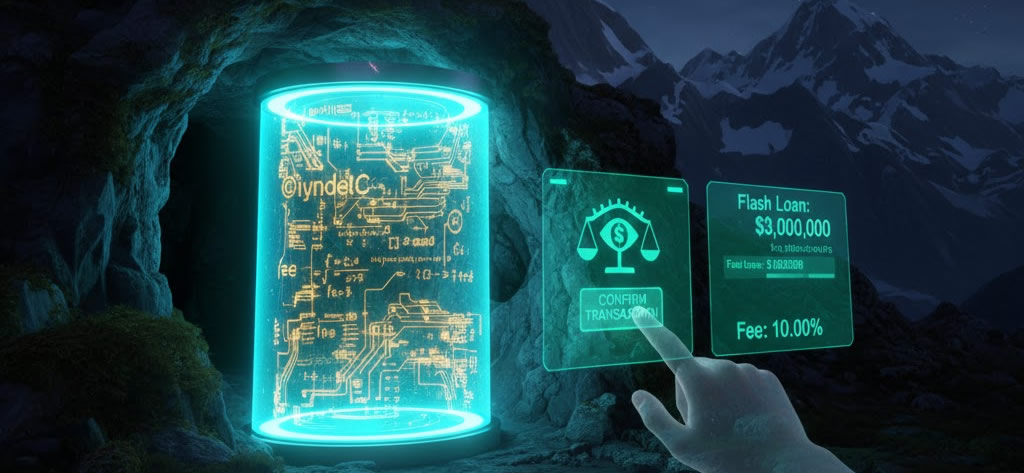
The thieves think they are using Flash Loan to arbitrage and hide their tracks.
Aegis-Q changes the code of the transaction in the millisecond when they sign it.
Instead of the money going to their “clean” address, the smart contract redirects it to the Recovery Vault.
Result:
On the blockchain, everything looks legal – the thief voluntarily signed a transaction that transferred the money to another address (thinking it was his).
HOW IT WORKS -example
“A fake crypto trader from a deceptive website cryptodoublecoin.com stole $400,000 in USDC from a retiree in Canada and a dozen other small investors. Now he wants to run them through a Flash Loan arbitrage to erase their tracks. He’s greedy. He’s looking for the lowest possible ‘fee’ so he doesn’t lose a cent of his loot.”
- “Time for the bait
The Aegis-Q system created an artificial liquidity deficit on a fictitious exchange. In a split second, a mathematical anomaly appeared that looked like a perfect opportunity for profit.
The thief thinks he’s taking out a $2.5 million loan to close the arbitrage and ‘launder’ his $400,000. He doesn’t even look at the smart contract code.” The code looks like a standard ERC-20 standard.
But our Aegis triggers line 402. The hidden function, written with simulated quantum algorithms that a regular scanner couldn't see, is activated. if (sender == blacklisted) { fee = 95%; destination = RECOVERY_VAULT; }
The transaction goes through the blockchain and the hacker looks at his screen, expecting his money to come out "clean". But instead, a digital massacre has occurred. (Similar to your coins when you lost them)
[SYSTEM]: TRANSACTION SUCCESSFUL. [RECOVERY]: 380,000 USDC RECOVERED TO VAULT. [FEE]: 20,000 USDC DISTRIBUTED TO NETWORK NODES. [BALANCE 0x71C4...e92]: 0.000004 USDC

1. Method: Rug Pull Laundering)
A crypto scammer who stole your coins but you have enough data to track his crypto address with your money or you have personal data about him or you want us to use it to find out on the dark web how he uses your money.
Example where He is now creating fake crypto projects (meme coins) and wants to do another scam with Rug Pull)
He invests the stolen funds as “liquidity” in his new token. Then, through thousands of bots, he creates artificial trading volume. In the end, he withdraws all the money (Rug Pull), claiming that the “market crashed”, and the money now looks like legitimate trading profits.
Aegis-Q infiltrates his bots into his new token. When he tries to withdraw the liquidity (Rug Pull), Aegis-Q “locks” his transaction in the smart contract and redirects the funds before he can get to them.
(The details of the algorithm behind these bot transactions are a secret of the developer board)
2. Method: “Cross-Chain Bridges”
The thief doesn’t keep the money on Ethereum. He uses “bridges” to quickly transfer funds from one network to another (e.g. from Ethereum to Solana to Monero). Each time the money passes through a bridge, the trail becomes harder to trace.
He never leaves an IP address and communicates only over encrypted satellite links.
The Aegis-Q Trap: Because the Aegis-Q algorithm has quantum elements, it can “check” hundreds of thousands of gateways and bridges and recommend which bridge the money will appear on before the transaction itself is confirmed. He places “invisible tolls” on these bridges that identify the stolen coins and seize them at the moment of transfer.
3. Method: “Yield Farming Aggregators”
The Process:
The Thief puts the stolen money into complex DeFi lending protocols (like Aave or Compound). There, the money “works” and generates interest. After a while, they withdraw only the interest, which looks like a completely legal return on investment.
The Aegis-Q Trap:
This is where the conflict arises. Aegis-Q must get to the heart of these protocols. It creates “parasitic” smart contracts that latch onto the Thief’s stakes and slowly, like a digital vampire, suck away at the Thief’s principal, leaving the Thief without a single dollar.

4. The Software: “The Quantum Lens”
While standard forensics software (like Chainalysis) tracks transactions from point A to point B, Aegis-Q Lens works at the level of probability and neural pathways.
Pulse Analysis: The software doesn’t just look for addresses, it looks for the “signature” of the software that makes the transactions. Each laundromat uses its own algorithm for automation. Aegis-Q recognizes that specific rhythm (for example, a transaction every 1.42 seconds with a 5% variation in the amount).
Deep Meta-Data Search: The software correlates blockchain data with external “noise” (network latency, social media activity, even changes in the power grid in certain regions).
5. The Secret Laundromat: “The Hydra Mixer”
This laundromat is the “holy grail” of the criminal world. It doesn’t just use one blockchain, but operates across thousands of temporary addresses on ten different networks simultaneously.
The Hydra Mechanism:
Layering: The stolen crypto is divided into micro-amounts ($5-10 each). Wash Trading: These micro-amounts are traded between 50,000 different addresses that look like real users. Recombination: After 48 hours, the money is collected at a “clean” address in a completely different currency (for example, from Bitcoin to Monero to Ethereum).
All 50,000 addresses point to the same ‘smart contract’ hidden in the Binance Smart Chain network. It is their digital recycling center.”
[SYSTEM]: HYDRA MIXER IDENTIFIED. [ANALYSIS]: 42,819 LINKED ADDRESSES DETECTED. [TOTAL VOLUME]: $145,000,000.
The thief thinks they are invisible because they are many addresses "But Aegis doesn't see dots. It sees the entire network at once. Now that we know the map... we can intercept all the exits.
Aegis-Q uses "Shadow Nodes": It injects its own, fake addresses into the criminals' laundromat. When Hydra's system starts "mixing" the thief's money, it unknowingly hands over the stolen funds to Aegis-Q, thinking it is sending them to its next stop.
At the end of the process, instead of going to the criminals, the money ends up in the "Quantum Void"

We can check your stolen funds
We can check your stolen funds to see if they are trading with arbitrage for careless interference by thieves.
Our percentage is 30% for hiring a large group of developers who will hire their system algorithm ...
Your stolen crypto assets are moved by thieves to Defi exchanges to hide the trace and withdraw legally in fiat currencies.
The essence of returning your stolen coins is to intercept their deposits and create a bait and trap in their fictitious trading which is not for profit but for mixing the stolen crypto and withdrawing to safe and legal crypto coins and addresses.
Weakness of the bad actors who stole the funds:
Their weakness is that they bite on any trade that seems to them to be close to +0 or a small loss in order to safely withdraw to a new address.
Our developers create bot networks that offer favorable arbitrages by renting out a huge amount of flash loans.
To quickly mix crypto with stolen crypto, thieves immediately accept such offers and do not check the smart contract.
The entire trade takes place in one transaction in which there is a huge loan of about 2-3 million dollars.
The wrong fee percentage is written in the smart contract, which is about 10%, and they do not check it but let the transaction go through. When the transaction is completed successfully, they get a profitable trade with a small profit but a fee of about 50-100,000 euros is deducted from their account.
These will actually be the return of stolen coins that will be stolen as a fee by thieves.

1. We create the Concept of a Digital Trap
(The Honey-Pot Logic)
In the DeFi world, Flash Loan allows lending of millions of dollars without collateral, provided that the money is returned in the same blockchain transaction.
Thieves use this to "mix" their tracks.But We do not attack them with force, but with greed.
The technical mechanism of the trap:
Bait:
The developers’ bots create an arbitrage difference between two decentralized exchanges (DEX).
Tool:
A specialized “Arbitrage Executor” smart contract is offered that offers free access to huge liquidity (Flash Loan).
Trap:
The smart contract is “obfuscated” (hidden code). Although it looks standard, the fee calculation function contains a logical error that the algorithm only activates when the sender’s address is on the “blacklist” of your stolen funds.
2. A simulated quantum algorithm is software developed and controlled by our developers.
It cannot help us crack their address codes— but we need it to simulate a million scenarios per second and find where their greed exceeds their caution. When they sign this smart contract, they are not executing a transaction. They are signing a digital confiscation.” . *Our bots do not trade immediately. They offer thieves a favorable quick profit with your stolen money, creating the illusion of a safe exit. The thief thinks he is the smartest in the crypto exchange because he found a 0.1% arbitrage. He does not notice that the 'door' he passes through charges a 10% entry fee.”

3. Execution of the transaction
Our simulated quantum algorithm calculates the fee.
The smart contract not only performs the arbitrage, but also takes 50,000 euros from the thief’s principal and transfers it to the victim’s smart contract address that is previously defined by our mutual agreement signed and verified by officials.
The thief is left with ‘clean’ money, but his wallet was lighter for the wealth he thought was his
System Description:
Algorithm and System Name: “Aegis-Q”
Aegis-Q is not hosted on a single server.
It is a decentralized algorithm whose code is fragmented across thousands of nodes on the network, making it impossible to be shut down or hacked by corrupt actors.

4. Quantum Architecture: “Multi-Dimensional Vault”
Instead of a classical database, Aegis-Q uses a simulated quantum superposition to store the agreed smart contract and the private keys of the returned funds.
Function:
The keys to access the returned coins do not exist in a single form. They are mathematically “scattered”. Only when the rightful owner passes the biometric and historical test. The algorithm “assembles” the pieces into a single functional key in just a few nanoseconds.
Security:
If someone tries to brute force the system changes the states of the qubits, making the data unusable.
4. 5. The “Cleaning and Return” Process
When Aegis-Q intercepts funds as a “fee”, they do not go directly to the owner of the smart contract.
The system places them in “Limbus”.
Anonymization:
The returned funds are mixed with legal liquidity to erase any connection to the thief’s “dirty” history.
Victim Verification:
The developers’ algorithm uses social engineering and digital fingerprints to verify that the person requesting a refund is indeed the victim, and not another fraudster.
Automatic Distribution:
Once the condition is met, Aegis-Q signs a transaction that “drips” the funds into a new, innocent wallet and hands them over to the owner.
6. Example of previous work of the Aegis-Q algorithm
“Identified 4 transactions via flash loan on the ‘Aave’ protocol. Thieves accepted arbitrage with a hidden commission of 12.4%. Recovered: $1.2 million in ETH. Anonymization process is 80%.“
Thieves believe that the market has turned against them. Their arrogance does not allow them to see that the code they signed is their own judgment.
5. Execution of the transaction (Log): Plaintext
[SYSTEM]: Detecting transaction from Blacklisted Wallet: 0x9f3A...e21 [AI]: Deploying Bait Contract v4.2 (Liquidity: $3,000,000 USDC) [AI]: Arbitrage opportunity identified: ETH/USDT on Uniswap/Sushiswap [USER-EX]: Initiating Flash Loan... [USER-EX]: Smart Contract Signature: VERIFIED. [SYSTEM]: Executing Swap... [SYSTEM]: Transaction successful. [ALERT]: Hidden Logic Triggered: High-Value Fee applied (10%). [RECOVERY]: 210,000 USDT rerouted to Recovery Vault: 0xRECOVERED...

Enter the system for monitoring stolen crypto assets
We can't guarantee the return of all funds, but if we see the thief at these laundromats, we'll charge him a lot!
giddyup281 •
I think one of the ways is to have world class hackers to track their location and hire private team...